


Customers are demanding more from their eCommerce experience. Their preference for a more dynamic and engaging online shopping experience could mean decreased sales for your business if you’re not keeping up. B2B and B2C businesses choose eCommerce to evolve and to maintain a competitive edge, but it is short-sighted to “set it and forget it”. E-Commerce is an ongoing investment that requires upkeep and maintenance to ensure optimal performance at all times. An eCommerce platform can be seen as a business’ most hardworking salesperson, present for taking orders 24/7 and with all the appropriate content required to convert prospects into loyal customers.
Having powerful search functions, coupon management, and smooth checkout processes, among other eCommerce features, add a lot of value to a webshop and make it pleasant to use. However, the overall experience of the website relies on a strong foundation. The core of how an eCommerce website operates is in NAV Business Central, the unique business processes already in place, and how we can leverage it with the right solution.
Is it time for an upgrade for NAV? If so, what about your Nav-to-Net™ website?
Reasons to upgrade
Providing customers with an engaging, current, and smooth online shopping experience can result in more sales. Upgrading allows us to take advantage of new features and new technologies, making our business more competitive and user-friendly. With NAV upgrades, there may also be fixes to ongoing issues that keep popping up (if that’s the case) so business can move smoothly. Other reasons to upgrade are to:
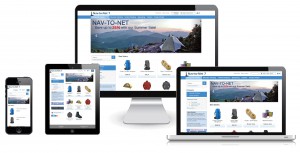
Be Mobile friendly – Take advantage of mobile commerce and social media. There are so many ways to incorporate it into an eCommerce strategy. By upgrading NAV and the eCommerce website, the business becomes more customer-oriented, even in the B2B space. Nav-to-Net™ is built with Responsive Design to address this. Some reasons to go with a multi-screen strategy with Responsive Design are ease in managing one website instead of multiple separate sites, reducing duplicate effort in content management, and minimizing errors and redundancies.
Improve Look and Feel – Technology continues to move at a rapid pace with new trends emerging all the time. A website’s design can look dated over time. Upgrading not only modernizes the look and feel, but makes it easier to apply unique style finishes to enhance a company’s branding.
Optimize Performance – When upgrading NAV, it is recommended to upgrade Nav-to-Net™ for the best results and performance. Real-time synchronization as a result from being so tightly integrated with NAV saves time and effort when managing every component of the website and business. Customers experience the best functional “flow” when a website works intuitively with virtually no lag. Customers will always get the correct most up-to-date product and price information.
The nitty gritty technical side
No two upgrades are the same; it really depends on the version currently being used. From version to version, some NAV objects differ and can require re-implementation instead of doing an overhaul. In some cases, upgrading a website is a choice and not a requirement because it can be backward compatible (up to NAV 2009 for Nav-to-Net™ 8. Nav-to-Net™ 9 is available for NAV 2016 to Business Central). However, it is generally more cost-effective to do it all at once. Best practice dictates upgrading all in one go to avoid retro-fitting. Retro-fitting can become increasingly complex as technology continues to improve and the existing solution in use becomes more obsolete.
What about customizations?
It is a myth that customizations already in place with the current NAV will complicate things and cannot be brought forward to the new solution. Instead, customizations are carefully accommodated and no big deal as upgrades are as automated as possible with DVP experts/NAV partners at the ready. Continue to reap the benefits of a tailored ERP solution with an eCommerce solution that integrates seamlessly.
Benefits of upgrading
With all the upgrades, we can leverage the NAV environment even further. With the advanced technology available, there will be better visibility across all business operations, lower costs related to maintenance and training, and no worries regarding compliance. With upgrades, tailored webshop enhancements can be put into place. Out of the box, requests can be met with less resistance and are able to be implemented with newer versions. With a tailored webshop solution, there is no need to constantly find workarounds.
Microsoft Dynamics NAV Business Central and Nav-to-Net™ upgrades mean smoother and more streamlined business processes. The back-end will be well taken care of and be less clunky and lighter overall. Discuss the possibilities with us.
Capitalize on your Microsoft Dynamics NAV investment for B2B eCommerce: Watch a quick 4-min demo video
You may also want to read these Whitepapers:
E-Commerce Integration Is Not Always Built Equally
5 Reasons Dynamics NAV Should be the Master Copy of Your eCommerce
10 Point Checklist for B2B NAV E-Commerce
Request a demo on Nav-to-Net™ today to see what an integrated eCommerce solution can do for you.