

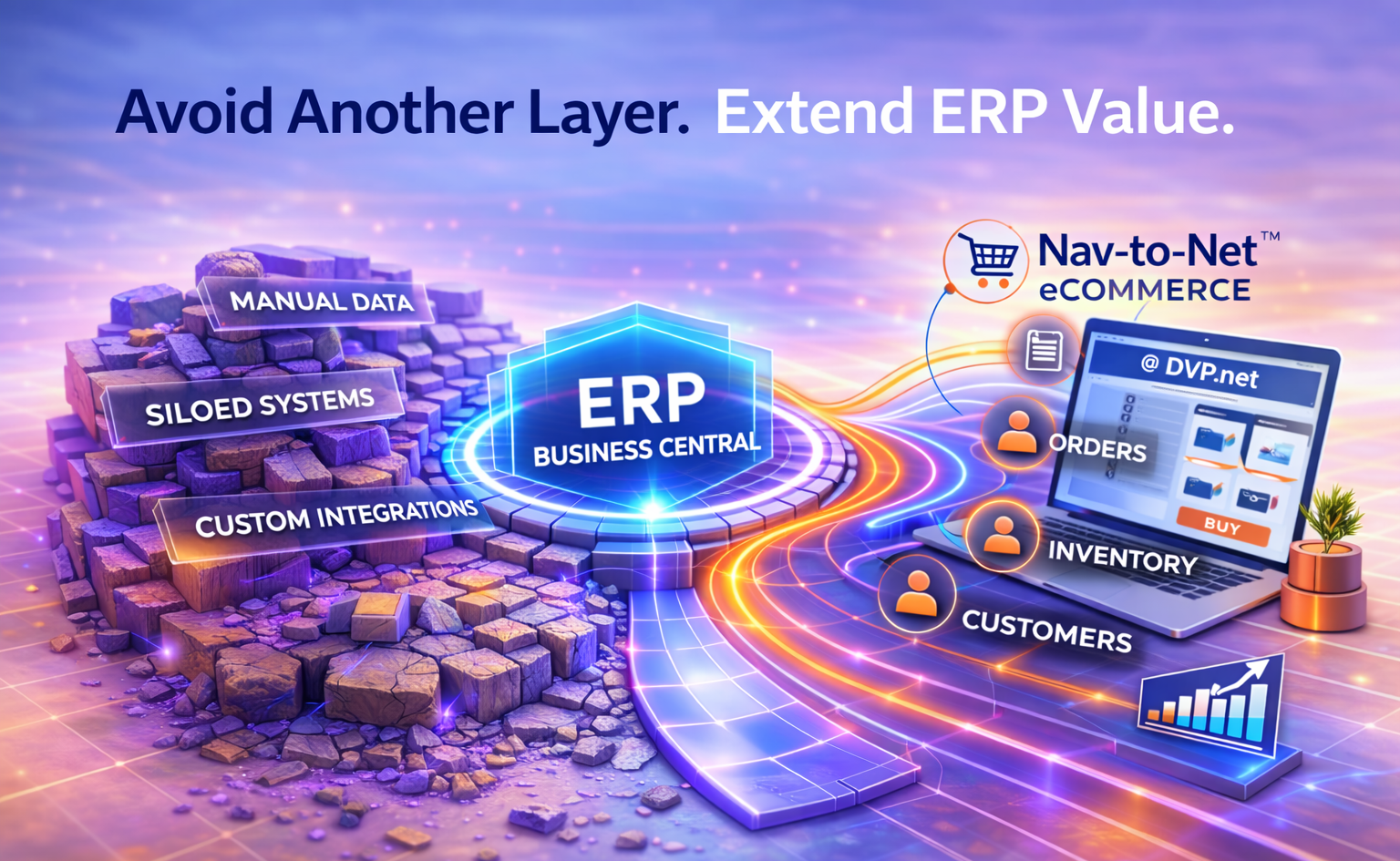
For companies using Microsoft Dynamics 365 Business Central or NAV, a Business Central eCommerce strategy should do more than create an online sales channel. It should extend the value of the ERP already running the business.
That is where many business decisions go wrong.
Leadership teams invest heavily in ERP to manage pricing, inventory, customer records, order processing, and financial control. Then they add eCommerce in a way that introduces another layer of systems, logic, and ongoing maintenance. What looks like digital progress can quickly turn into more complexity, more manual work, and less return on the ERP investment already made.
That is why ERP-governed commerce matters.
For executive teams, this is not simply a website decision. It is a decision about control, scalability, and whether eCommerce will strengthen the business or create more friction around it.
Avoid Another Layer. Extend the Value of Your ERP.
The issue is not whether your business needs eCommerce. Most do.
The issue is whether the eCommerce model really leverages Business Central or works around it.
When the online channel operates separately, the business often ends up managing two environments instead of one connected operating model. Pricing must stay aligned. Inventory must stay aligned. Customer-specific rules, order status, taxes, and reporting all have to stay aligned too. Every gap between systems creates more room for drift, more manual intervention, and more hidden cost.
That cost is not only technical. It affects customer experience, financial visibility, operational efficiency, and leadership confidence.
A stronger approach is to build digital commerce from the ERP outward. That allows the business to leverage the system it already trusts rather than add another disconnected layer to manage.
How ERP-Governed Commerce Helps Protect ERP ROI
Companies using Business Central or NAV have already spent time, money, and internal effort choosing the right ERP. eCommerce should build on that decision, not weaken its return.
When digital commerce is governed by the same logic already running the company, businesses are in a stronger position to keep pricing consistent, support customer-specific requirements, improve inventory visibility, and maintain cleaner order flow. Reporting becomes more useful because teams are not constantly reconciling multiple versions of the truth.
This is how eCommerce becomes more than a sales channel. It becomes a way to maximize ERP ROI.
Instead of investing in disconnected tools that duplicate core logic, leadership can extend the value of the ERP into the customer experience itself. That is a smarter long-term model for growth.
Where does your eCommerce architecture fall on the governance spectrum?
This maturity model helps Business Central leaders assess whether their digital commerce approach is simply connected to their ERP or truly governed by it.
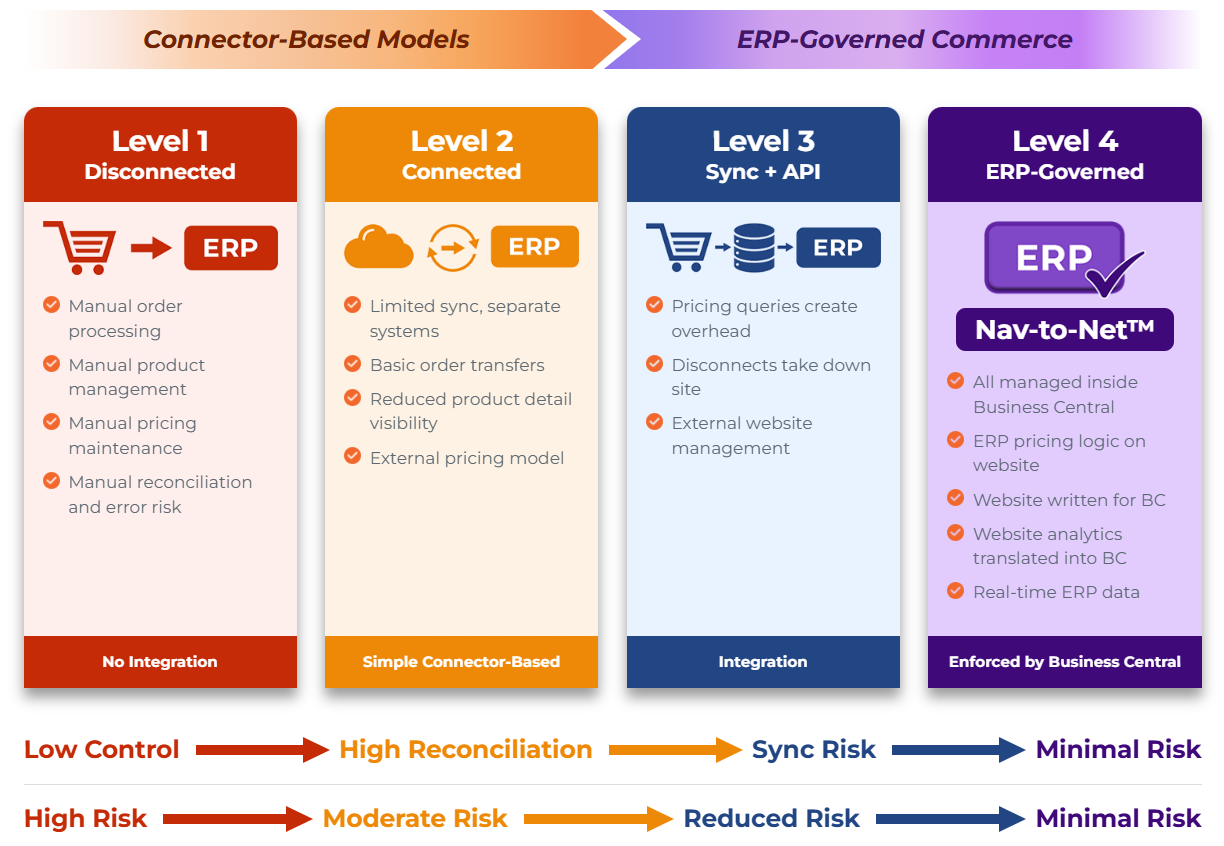
Figure: ERP Governance Maturity Model for Business Central eCommerce
Organizations at the lower end of the model often face more operational workarounds, reduced visibility, and greater risk of misalignment between commerce activity and ERP logic. As governance maturity increases, digital commerce becomes more controlled, scalable, and better aligned with the system already trusted to run the business.
Our governance maturity model supports this evaluation by helping Business Central leaders determine whether their eCommerce approach is simply connected to the ERP or truly governed by it. It offers a practical way to assess control, complexity, and how closely digital commerce is aligned to the ERP investment already in place.
How to Evaluate a Business Central eCommerce Strategy
If your company is launching a new webstore or rethinking an existing one, the right conversation should go beyond design, features, or speed to launch.
Those factors matter, but they are not what determine long-term business value.
A better executive lens includes questions like:
- Will this approach help us get more value from our ERP investment?
- Will it reduce or increase complexity over time?
- Can it support our business logic, not just generic storefront functionality?
- Will it improve control and visibility as the business grows?
- Is it extending from Business Central, or just connecting back to it?
These are the questions that move the discussion from surface-level platform comparisons to strategic business decision-making.
Why ERP-Governed Commerce Is a Smarter Growth Model
Growth is not just about generating more online orders. It is about supporting that growth without increasing friction behind the scenes.
ERP-governed commerce helps leadership reduce operational drag, maintain stronger control, and create a more dependable foundation for scale. It keeps digital commerce closer to the operational system already trusted to run the business.
For company leaders using Business Central leaders, that matters.
The goal is not simply to have an online store. The goal is to build a digital commerce model that protects prior investment, reduces avoidable complexity, and supports sustainable growth.
Business Central eCommerce Should Strengthen ERP, Not Work Around It
For companies using Business Central or NAV, eCommerce should not sit beside the ERP as another layer to manage. It should extend from it.
That is what ERP-governed commerce makes possible.
It helps reduce complexity, strengthen control, and maximize the value of the ERP investment already made.
You can also read our companion perspective on ERP Software Blog here: Business Central eCommerce: Maximize ERP ROI
Ready to Build a Smarter eCommerce Strategy?
If you are evaluating a new webstore or questioning whether your current eCommerce model is creating more complexity than value, now is the time to take a closer look.
See how Nav-to-NetTM is fully managed inside Business Central — and how ERP-governed commerce can help you reduce friction, improve control, and build a stronger foundation for growth.