

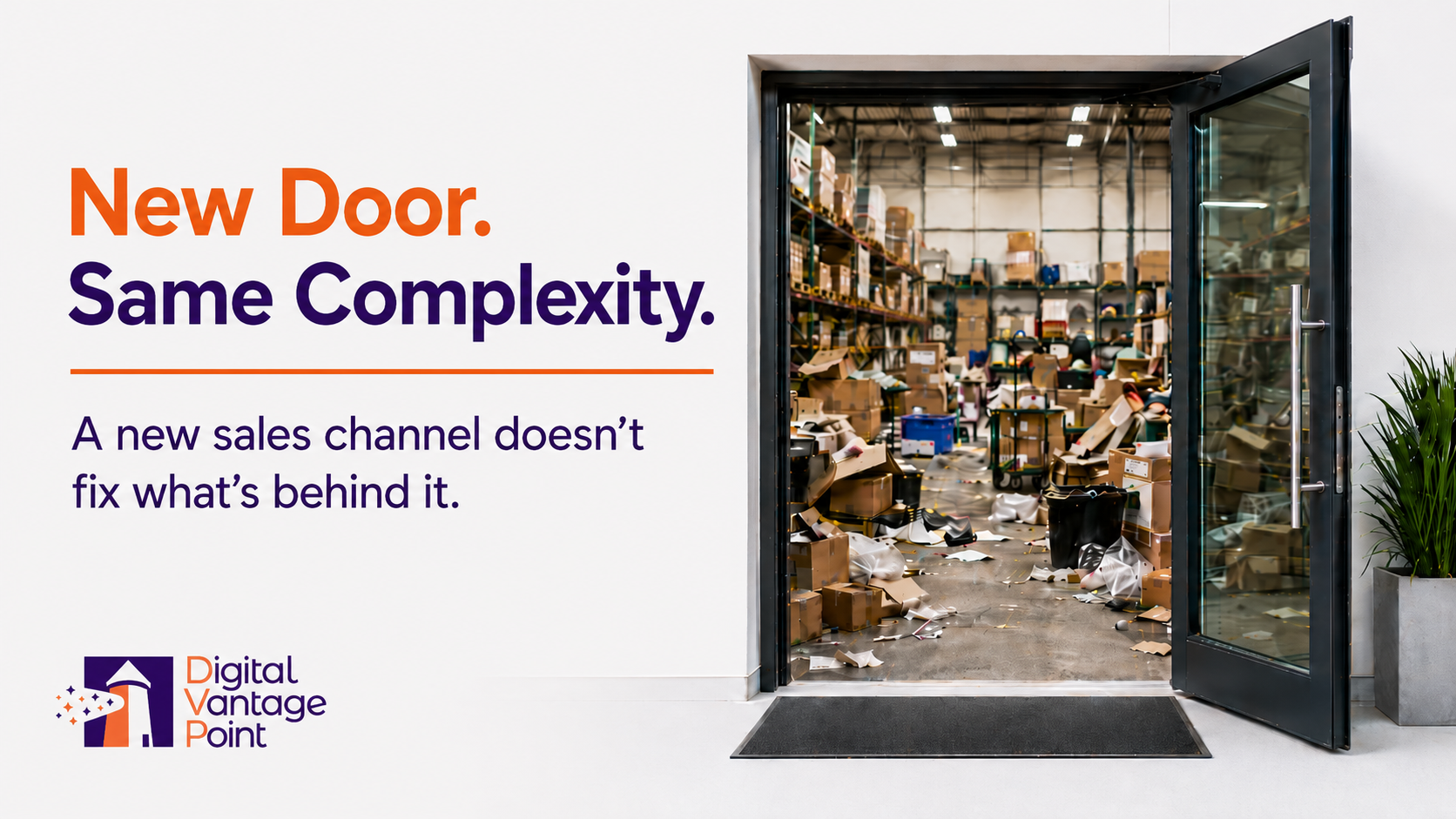
B2B eCommerce Is No Longer Just a Website Decision
For manufacturers and distributors, B2B eCommerce has moved far beyond the question of whether customers should be able to place orders online.
That question has already been answered.
Today’s B2B buyers expect digital access. They expect product information, account details, pricing, order history, invoices, reports, availability, and service options to be easier to find and easier to act on. They may still rely on sales representatives, customer service teams, distributors, dealers, contractors, branch managers, procurement teams, or account managers, but they also expect the buying process to be more efficient than it used to be.
The larger executive question is no longer:
Do we need eCommerce?
The better question is:
How mature is our eCommerce model, and is it strong enough to support how our business actually sells, fulfills, and serves customers?
That distinction matters.
A company can have an online store and still have an immature commerce model. It can accept online orders but still depend on manual corrections behind the scenes. It can display products online but still struggle with customer-specific pricing, inventory accuracy, account rules, approvals, substitutions, backorders, or order visibility. It can invest in a polished website while still forcing sales, customer service, finance, operations, and IT teams to reconcile data across disconnected systems.
That is why B2B eCommerce maturity matters more than simply adding another sales channel.
For C-level leaders in manufacturing and distribution, eCommerce should not be viewed as a side project, a web refresh, or a digital convenience. It should be viewed as a business requirement that connects customers, sales, operations, finance, inventory, fulfillment, and ERP data into a more scalable commerce model.
When that maturity is missing, eCommerce can create more complexity instead of more growth.
What B2B eCommerce Maturity Really Means
B2B eCommerce maturity is not about having the most attractive website or the longest list of front-end features, although both still matter. True maturity is measured by whether the online channel reflects how the business actually operates.
For manufacturers and distributors, that reality is rarely simple. Customers may have different pricing agreements, contract terms, credit limits, tax rules, freight requirements, product restrictions, approval workflows, ship-to locations, order minimums, and account structures. Products may have variants, substitutions, availability rules, lead times, custom configurations, or industry-specific requirements.
A mature B2B eCommerce model can support that complexity without pushing it into disconnected workarounds.
It allows customers to interact with the business digitally while still respecting the rules that already govern the business. It makes the online channel part of the company’s operating model rather than a separate layer that has to be managed, synchronized, corrected, and explained.
In a mature model, eCommerce does not sit off to the side.
It is connected to the same data, logic, and decisions that already matter across the business.
That includes:
- Customer-specific pricing
- Product and item data
- Inventory availability
- Account terms and credit rules
- Order history and reorder logic
- Shipping and fulfillment rules
- Approval workflows
- Customer hierarchies and ship-to accounts
- Order status, invoices, reports, and payment history
This is where many B2B eCommerce projects become more complex than expected. The front end may look simple, but the business rules behind the buying experience are not simple at all.
For executives, this is the real maturity test:
Not whether the company has eCommerce, but whether the eCommerce model can support the way the company actually operates.
Why Treating eCommerce as Another Sales Channel Falls Short
Many B2B companies originally approached eCommerce as an added sales channel.
The logic was understandable. Customers were buying online, so the business needed a web store. The online channel became another way to accept orders alongside sales representatives, customer service, email, phone, EDI, dealers, distributors, and other established channels.
But for manufacturers and distributors, that approach can create long-term complexity when eCommerce is treated separately from the systems and processes that govern the rest of the business.
A disconnected online channel may require separate product data, separate pricing logic, separate customer rules, separate inventory visibility, separate order handling, and separate reporting. Even when integrations are used to connect systems, the business may still need to manage exceptions, corrections, and duplicated logic across multiple technologies.
That creates hidden operational drag across the business:
- Sales teams explain pricing differences
- Customer service corrects orders
- IT maintains integrations and troubleshoots data issues
- Finance reconciles transactions
- Operations manages fulfillment exceptions caused by inaccurate availability or incomplete order details
- Customers lose confidence when the online experience does not reflect the account relationship they already have with the business
The issue is not that eCommerce exists as a channel.
The issue is when the channel is not mature enough to operate as part of the business.
For manufacturers and distributors, the goal should not be to add another technology layer to manage. The goal should be to create a commerce model that extends the company’s ERP-governed business processes into the customer experience.
That is a very different executive standard.
Why B2B eCommerce Maturity Matters to the C-Suite
B2B eCommerce maturity is not only a marketing or IT topic. It affects growth, margin protection, operational efficiency, customer retention, and long-term scalability.
- For CEOs: Does eCommerce strengthen the company’s ability to compete, serve customers, and grow without adding unnecessary complexity?
- For CFOs: Does it protect margins, improve return on ERP and technology investments, reduce manual work, and avoid the cost of disconnected systems?
- For CIOs and CTOs: Is the architecture governed, scalable, secure, maintainable, and aligned with the ERP?
- For COOs: Does it improve order accuracy, fulfillment reliability, inventory visibility, workflow efficiency, and operational control?
- For sales and customer service leaders: Does it give customers better self-service while allowing internal teams to focus on higher-value relationship and support activities?
That is why mature B2B eCommerce should not be evaluated only by the look of the website or the number of features available. It should be evaluated by how well the online channel supports the way the business actually operates.
A mature eCommerce model helps executives evaluate whether the online channel is actually supporting the business:
- Customers see the right products for their account.
- Account-specific pricing is accurate and available online.
- Reordering is fast, reliable, and easy to complete.
- Order history, invoices, reports, shipment status, and account details are accessible without extra support.
- Online orders move through the business without duplicate entry or unnecessary manual correction.
- Sales and customer service teams can trust the same information customers see online.
- The business can scale digital order volume without adding more manual processes.
- Executives have confidence in the data behind the channel.
These indicators are more important than whether the company has launched a portal, storefront, or ordering site. They reveal whether eCommerce is creating business leverage or simply adding another place for customers to transact.
B2B Buying Is More Complex Than a Simple Online Cart
Modern B2B buying is rarely handled by one person making one simple transaction.
Forrester has reported that 73% of B2B purchases now involve three or more departments, with an average of 13 people inside the buyer’s organization and nine external participants involved in the decision. For manufacturers and distributors, that has major implications for eCommerce.
The online experience cannot only support a buyer adding products to a cart. It may need to support purchasing teams, finance teams, operations teams, sales representatives, customer service teams, approvers, dealers, distributors, contractors, branch locations, and multiple ship-to accounts.
That level of buying complexity makes eCommerce maturity more important.
When multiple stakeholders depend on the same supplier relationship, the information they see online must be accurate, consistent, and governed. Product data, account-specific pricing, customer terms, order history, inventory availability, invoices, reports, approvals, and fulfillment details all need to reflect the real business relationship.
If the online experience provides incomplete or inconsistent information, it does not simply create a website issue. It creates friction across the customer relationship.
A mature B2B eCommerce model helps reduce that friction by making the online experience reflect the real account relationship, not just the product catalog.
The Manufacturing and Distribution Challenge
Manufacturing and distribution companies face a different eCommerce challenge than many consumer-facing retailers.
In B2C, the buying experience is often built around product discovery, shopping cart conversion, promotions, and consumer convenience.
In B2B manufacturing and distribution, the buying experience is often built around account relationships, negotiated pricing, availability, contract terms, order accuracy, fulfillment reliability, and long-term trust.
That changes both the maturity and governance requirements.
A distributor may need to show different pricing to different customer accounts. A manufacturer may need to support dealers, contractors, wholesalers, distributors, or end customers differently. A customer may need access to approved items, replacement parts, order templates, invoices, shipment tracking, custom reports, or special freight options. Some buyers may need purchasing approvals. Others may need support for multiple ship-to addresses or account-level order history.
These are not minor details.
They are the details that determine whether customers trust the online channel.
If a customer logs in and sees the wrong price, they may call sales. If inventory is inaccurate, they may hesitate to order. If order history is incomplete, they may revert to email. If approvals are not supported, purchasing teams may avoid the site. If account terms are not reflected correctly, finance and customer service may need to step in.
This is why B2B eCommerce maturity depends on more than front-end design.
The online experience must be supported by the operational backbone of the business.
For many companies using Microsoft Dynamics 365 Business Central, that backbone is the ERP system. It is where much of the company’s customer, item, pricing, inventory, order, and financial logic already lives.
The more eCommerce can respect and extend that ERP-governed foundation, the more mature the commerce model becomes.
The Risk of Disconnected Commerce
Disconnected commerce often starts with good intentions.
A company wants to move quickly. It wants a modern website. It wants customers to order online. It wants to reduce manual effort. It may choose an eCommerce platform first and then try to connect it to ERP afterward.
At first, that can seem practical.
But over time, the business may discover that the eCommerce system needs its own data structures, rules, workflows, and workarounds. Integration becomes a constant project. Data must be synchronized. Exceptions must be managed. Custom logic must be rebuilt outside the ERP. Teams begin asking which system is correct.
That can lead to a familiar set of problems:
- Pricing discrepancies between ERP and the website
- Inventory information that is delayed or incomplete
- Customer account data that must be duplicated
- Orders that require manual review before processing
- Business rules that are recreated outside the ERP
- Reporting gaps across channels
- Higher IT maintenance
- More operational dependency on integrations
- Customer confusion when online information differs from account reality
For executives, this is where eCommerce can become expensive in ways that are not obvious at the beginning.
The cost is not only the software.
The cost is the operational complexity created when commerce is not governed by the same system of record as the business.
That is why maturity should be considered before platform selection, not after implementation.
What a More Mature B2B eCommerce Model Looks Like
A more mature B2B eCommerce model starts by recognizing that the website is only the visible part of the commerce experience.
The real value comes from what the customer can do accurately, confidently, and efficiently.
A mature model allows customers to log in and interact with the business in a way that reflects their actual business relationship. They can see relevant products, accurate pricing, appropriate availability, order history, invoices, reports, and account-specific options. They can reorder without starting from scratch. They can submit orders that flow into the business without unnecessary rekeying. They can trust that what they see online reflects the company’s operational reality.
Internally, a mature model helps teams work more efficiently.
Sales representatives can focus on account development instead of routine order entry. Customer service teams can spend less time answering repetitive questions. Finance can rely on consistent customer terms and order data. Operations can fulfill orders with fewer surprises. IT can support a cleaner architecture. Executives can gain better visibility into commerce activity.
Most importantly, the company can scale without simply adding more people or more manual process.
That is the difference between launching eCommerce and maturing eCommerce.
One creates a new channel. The other creates a stronger business capability.
A Practical B2B eCommerce Maturity Lens for Executives
Executives do not need to evaluate every eCommerce feature in detail. But they do need to ask better strategic questions.
A useful B2B eCommerce maturity lens includes five areas.
1. Data Maturity
Data maturity asks whether customers and internal teams can trust the information behind the online channel.
For manufacturers and distributors, that includes product data, customer-specific pricing, inventory availability, account terms, order history, invoices, reports, and shipment information.
If customers see incomplete or inaccurate information online, the business may have a data governance issue, not just an eCommerce issue. B2B buyers are not only browsing. They are making decisions that may affect purchasing, production, customer commitments, inventory planning, or job timelines. If the data is unreliable, the channel becomes harder to trust.
2. Process Maturity
Process maturity asks whether online orders can follow the same business logic that governs offline orders.
That may include approval workflows, customer-specific rules, tax logic, credit terms, shipping rules, minimum order requirements, product restrictions, and fulfillment processes.
If these rules are handled manually after an online order is submitted, the business may not be ready to scale digital commerce efficiently. A mature eCommerce model should support the way the business operates, not create a separate version of the business that requires additional correction and oversight.
3. ERP Alignment
ERP alignment asks whether eCommerce is extending the value of the ERP system or duplicating logic outside of it.
For companies using Microsoft Dynamics 365 Business Central, this is one of the most important maturity questions. If Business Central is the system of record for customer data, item information, pricing, inventory, orders, reporting, and financial logic, the eCommerce model should respect that role.
When eCommerce is disconnected from the ERP foundation, the company may be forced to maintain the same logic in multiple places. That weakens governance and increases operational complexity.
4. Customer Experience Maturity
Customer experience maturity asks whether the online channel supports how B2B customers prefer to buy.
For manufacturers and distributors, that may include reorder tools, account-specific catalogs, quote-to-order processes, role-based access, multiple ship-to locations, order history, invoice and report access, portal support tools, and self-service account information.
B2B buyers are not all the same. A purchasing manager, dealer, contractor, finance approver, branch location, and operations team may each need different information from the same supplier. A mature eCommerce experience should reflect that complexity without making the buying process harder.
5. Operational Maturity
Operational maturity asks whether eCommerce reduces internal workload or creates more work behind the scenes.
A mature model should reduce duplicate entry, manual corrections, unnecessary customer service volume, pricing disputes, order delays, and avoidable fulfillment issues.
The strongest eCommerce strategies do more than improve the customer-facing experience. They also help the business operate more efficiently.
Together, these five areas help executives avoid the trap of evaluating eCommerce only by design, features, or speed to launch.
The strongest B2B eCommerce strategies are built around operational truth, not just digital presentation.
Why B2B eCommerce Maturity Matters for Business Central Companies
Companies using Microsoft Dynamics 365 Business Central often already have a strong operational foundation.
Their ERP manages important and often vague business logic. It supports financials, customers, items, pricing, inventory, order processing, purchasing, warehouse activity, and reporting. In many manufacturing and distribution companies, it is the place where the business understands what is true.
That makes the ERP’s role in eCommerce especially important.
If eCommerce is disconnected from that foundation, the business may be forced to recreate important logic elsewhere. That can weaken governance and introduce unnecessary complexity.
If eCommerce is aligned with that foundation, the company can extend ERP value into the customer experience.
This is where ERP-governed commerce becomes so important.
ERP-governed commerce means the online buying experience is shaped by the same system of record and business rules that already guide the company’s operations. It does not mean every experience is rigid or limited. It means the customer-facing experience is grounded in accurate data, governed rules, and operational consistency.
For manufacturers and distributors, that can be a major advantage.
It allows eCommerce to become a more reliable extension of the business, rather than a separate digital storefront that has to be constantly reconciled with the business.
B2B eCommerce Maturity Is Not About Enabling Everything at Once
B2B eCommerce maturity does not mean every company needs every feature immediately.
In fact, trying to do too much at once can create its own risk.
A more effective initial approach is to identify which commerce capabilities will create the most value based on the company’s customers, operations, and business model.
For some companies, the priority may be accurate online ordering for existing customers. For others, it may be reorder functionality, customer-specific pricing, dealer portals, product availability, replacement parts, account self-service, quote requests, reporting, or reducing manual order entry.
The right maturity path depends on the business.
But the underlying principle is the same:
The eCommerce roadmap should be guided by business value and operational readiness, not by generic feature lists.
That is why executives should be involved early. eCommerce decisions affect architecture, sales process, customer experience, fulfillment, finance, and long-term scalability. These decisions should not be made in isolation by one department.
A maturity-based eCommerce strategy starts with alignment.
Before comparing platforms or feature lists, manufacturers and distributors should clarify what the business needs the online channel to improve. That means looking at where customers experience friction, where internal teams lose time, and where disconnected processes create risk.
The right questions include:
- What do customers need most to buy with confidence?
- Which manual processes are slowing down growth?
- Where are errors, delays, or inconsistencies affecting trust?
- Which parts of the buying experience should be governed by ERP data?
- Where does the business need stronger control over pricing logic, inventory, orders, and customer-specific rules?
- How should eCommerce reduce complexity instead of adding another system to manage?
These questions lead to better decisions than simply asking which platform has the most features. They help executives focus on business value, operational readiness, and the level of maturity needed to support long-term growth.
The Business Case for B2B eCommerce Maturity
B2B eCommerce maturity is becoming a defining issue for manufacturers and distributors.
Customers want digital access, but they also want accuracy. They want convenience, but they still need account-specific pricing, reliable inventory, clear order status, and support for the way their business buys. They want self-service, but not at the expense of trust.
For the companies serving them, that means eCommerce cannot be treated as just another sales channel.
It must be treated as part of the operating model.
Manufacturers and distributors that mature their eCommerce strategy around ERP alignment, accurate data, customer-specific rules, and operational efficiency will be better positioned to grow without adding unnecessary complexity.
Companies that treat eCommerce as a disconnected layer may still launch a site, but they may struggle to create a scalable, trusted, and profitable digital commerce experience.
For C-level leaders, the message is clear:
A website can take orders.
A mature commerce model can strengthen the business.
That is the difference that matters.
Ready to Evaluate Your B2B eCommerce Maturity?
Digital Vantage Point helps manufacturers and distributors using Microsoft Dynamics 365 Business Central create ERP-governed eCommerce experiences that are fully managed inside Business Central.
Powered by Nav-to-Net™ (NTN), DVP’s purpose-built ERP-governed eCommerce solution for Business Central, companies can extend ERP value into the customer-facing buying experience while keeping pricing, inventory, customer data, orders, reporting, and business rules aligned with the ERP.
NTN is designed to support the maturity areas discussed in this article, including customer self-service, account-specific pricing, order accuracy, custom reporting, ERP alignment, operational efficiency, and a more scalable B2B eCommerce model.
If your organization is evaluating B2B eCommerce, replacing a disconnected platform, or trying to get more value from your Business Central investment, DVP can help you assess what a more mature commerce model should look like for your business.
Schedule a personalized walkthrough to see how Nav-to-Net™ helps customers order online while keeping commerce governed by Business Central.
Build a more mature B2B eCommerce model inside Business Central

Coming Next in the Series
Article 2: Your ERP Investment Should Do More Than Run the Back Office
In the next article, we will look at why manufacturers and distributors should expect more from their ERP investment, and how Business Central can become the foundation for a stronger, more connected eCommerce experience.