

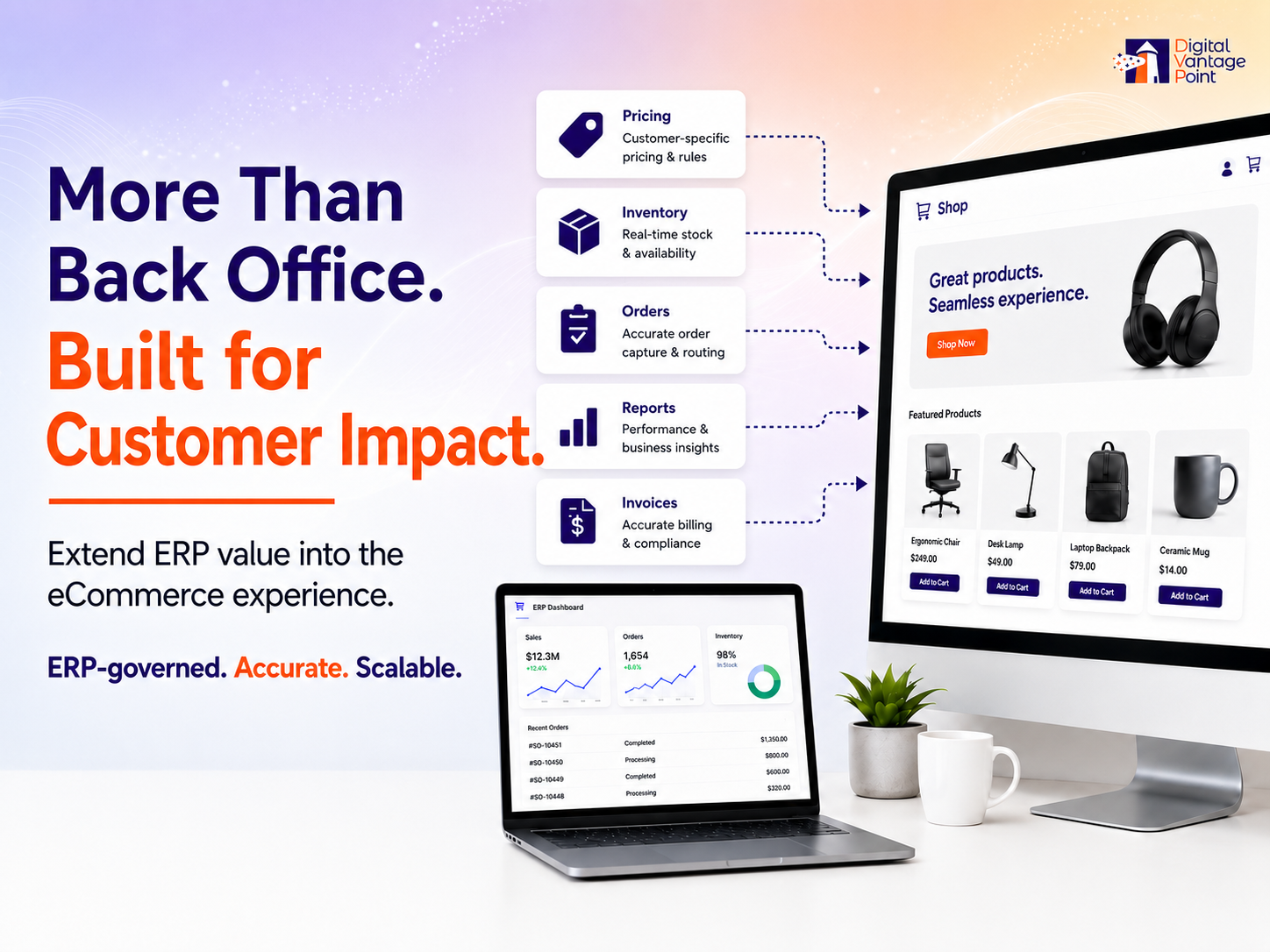
ERP Should Be More Than a Back-Office System
For many manufacturers and distributors, Microsoft Dynamics 365 Business Central is one of the most important systems in the business.
It manages financials, customers, items, pricing, inventory, purchasing, orders, fulfillment, reporting, and the operational logic that keeps the company moving. It is where the business understands what is true, what is available, what is owed, what has been ordered, what has shipped, and what rules apply to each customer relationship.
Yet when companies evaluate eCommerce, the ERP is sometimes treated as a system to connect after the website decision has already been made.
That can be a costly mistake.
If Business Central is the system of record for customer data, pricing, inventory, orders, invoices, and business rules, then eCommerce should not sit outside that foundation. It should extend the value of the ERP into the customer experience.
For C-level leaders, this is an important distinction.
The question is not only whether the company has invested in ERP.
The better question is whether the business is getting enough value from that ERP investment beyond internal operations.
If the ERP is trusted inside the business but disconnected from the customer-facing buying experience, then customers may still be forced to call, email, or wait for support to access information the company already has.
That creates a missed opportunity.
A mature Business Central eCommerce strategy should help customers interact with the same pricing, inventory, order history, account rules, and business logic the company already relies on internally.
That is how ERP moves from back-office system to commerce foundation.
Why ERP Value Should Extend Into the Customer Experience
ERP systems are often evaluated by how well they support internal efficiency.
Executives often evaluate ERP value through questions such as:
- Can finance close faster?
- Can operations manage inventory more accurately?
- Can purchasing plan better?
- Can orders be processed more consistently?
- Can leadership trust the reporting?
Those questions matter. But for manufacturers and distributors, ERP value should not stop at the internal edge of the organization.
Customers increasingly expect access to information that already lives inside the ERP. They want to know which products are available. They want to see their pricing. They want to review previous orders. They want to reorder familiar items. They want access to invoices, shipment details, and account information. They want confidence that the online experience reflects their actual relationship with the business.
If those details are locked inside the ERP but unavailable online, the business may still be relying on people to bridge the gap.
Sales teams answer routine product or pricing questions. Customer service teams send order updates. Finance teams respond to invoice requests. Operations teams clarify availability. IT teams maintain data connections between systems. Executives may wonder why the company invested in both ERP and eCommerce but still depends on manual work to support basic customer needs.
That is why ERP value should be measured not only by what the system does internally, but by how well it supports the customer-facing experience.
For Business Central companies, eCommerce can become one of the clearest ways to extend ERP value.
When done well, customers gain access to trusted data and self-service capabilities. Internal teams reduce repetitive work. Leadership gains a more scalable commerce model. The business avoids duplicating logic in multiple systems.
When done poorly, eCommerce can become another layer that has to be synchronized, maintained, explained, and corrected.
That is not ERP leverage.
That is system sprawl.
Why Digital Self-Service Raises the Value of ERP Alignment
B2B buyers increasingly expect digital access to the information and tools they need to move purchases forward. That does not mean every customer wants a fully automated buying experience, and it does not mean sales and service teams become less important. It means customers expect routine buying tasks to be easier, faster, and more reliable online.
Forrester’s 2025 B2B marketing and sales predictions state that more than half of large B2B purchases of $1 million or more will be processed through digital self-service channels, including a vendor’s website or marketplace.
For manufacturers and distributors using Business Central, that shift raises an important executive question: is the ERP investment only supporting internal operations, or is it also helping customers access accurate pricing, inventory, order history, account terms, and self-service buying capabilities online?
This is not only a website issue.
It is an ERP alignment issue.
From the customer’s perspective, self-service may seem simple. A buyer wants to log in, find the products they need, confirm pricing and availability, review previous purchases, and place an order or reorder without unnecessary delays.
But behind that experience are many business rules and data points.
The product must still be active. The customer must be allowed to buy it. The correct price must be applied. Inventory or availability expectations must be reliable. The right ship-to location must be available. Account terms may need to be respected. Order minimums, freight rules, tax treatment, credit status, or approval rules may need to apply.
If those rules live in Business Central but the website does not reflect them accurately, digital self-service becomes risky. A customer may place an order that later requires correction. Internal teams may need to intervene. Sales or customer service may need to explain discrepancies. The online channel may capture the transaction, but the business still has to manage the complexity manually.
That is why self-service is such a useful test of Business Central eCommerce maturity.
It reveals whether the online channel is truly extending ERP value into the customer experience, or simply creating another place where customers can start a transaction that the business still has to clean up behind the scenes.
Reordering is one of the most important areas where ERP value can become visible to the customer.
For many manufacturers and distributors, a large share of revenue comes from existing customers buying familiar products, replacement parts, supplies, materials, or repeat-order items. These customers may not need a long product discovery journey. They need speed, accuracy, and confidence.
They need to know:
- What did we order last time?
- Is the item still available?
- Has the price changed?
- Is this product approved for our account?
- Can we ship to the same location?
- Can we reorder without rebuilding the cart?
- Will the order flow correctly through the business?
These are not just eCommerce questions.
They are ERP questions.
Business Central already holds much of the information needed to answer them. The opportunity is to make that information available in a customer-facing way without weakening governance.
When reordering is supported well, the customer experience improves and internal workload can decrease. Buyers complete routine purchases faster. Sales teams spend less time on low-value order entry. Customer service teams receive fewer repetitive requests. Orders can move through the business with fewer corrections.
When reordering is not supported well, customers may default to email, phone, spreadsheets, or old purchase orders. That may still get the order placed, but it limits scalability and keeps unnecessary friction in the process.
For executives, the question is not simply whether customers can reorder online.
The better question is whether the business can make reordering accurate, governed, efficient, and scalable.
That is where Business Central eCommerce becomes strategic.
The CFO View: Turning ERP Investment Into Business Leverage
Disconnected Commerce Can Weaken ERP ROI
For CFOs, ERP investment is not only a technology decision. It is a business performance decision.
The ERP represents a significant investment in financial control, process consistency, reporting, operational visibility, and governance. If eCommerce is disconnected from that investment, the company may end up paying for duplicate systems, duplicate data maintenance, additional integrations, manual reconciliation, and avoidable corrections.
That can weaken the return on both ERP and eCommerce.
A more mature approach asks how eCommerce can help the company get more value from the ERP it already trusts.
For example:
- Customer-specific pricing can be governed from the system of record
- Inventory and availability information can be aligned with operational reality
- Orders can flow into the business with less rekeying
- Account terms and credit rules can remain consistent
- Customer self-service can reduce repetitive support costs
- Reporting can become more reliable because fewer decisions happen outside the ERP
When these areas stay aligned with Business Central, eCommerce can support financial control instead of creating another layer for the business to reconcile.
This matters because disconnected commerce often creates costs that are not obvious at the beginning.
The website may launch successfully, but internal teams may still spend time correcting pricing, validating inventory, checking orders, reconciling data, or explaining discrepancies to customers. Over time, those hidden costs can reduce the value of the eCommerce investment.
For CFOs, the strongest Business Central eCommerce strategy is not necessarily the one with the most front-end features.
It is the one that protects business logic, reduces duplicate work, supports margin control, and helps the company scale without adding unnecessary operating cost.
The CIO View: Architecture Matters Before the Website Goes Live
Architecture Decisions Become Business Decisions
For CIOs, the issue is architecture.
A modern website can look polished, but if it depends on duplicated data, fragile integrations, or business rules recreated outside the ERP, the architecture may become difficult to maintain.
Business Central often holds the operational logic that other systems depend on. When eCommerce is designed separately and connected later, the company may need to decide which system controls pricing, inventory visibility, customer rules, product data, order status, and approvals.
Those decisions have long-term consequences.
If business logic is duplicated outside the ERP, changes must be maintained in more than one place. If integrations are too complex, every system update can create risk. If data flows are delayed or incomplete, customers may see information that does not match reality. If order processing requires too much exception handling, internal teams may lose confidence in the channel.
This is why eCommerce architecture should be considered before platform selection, not after.
The ERP Should Govern the Logic That Matters Most
For Business Central companies, the goal should be to keep the ERP as the source of truth for the decisions that matter most. That does not mean the website experience should be limited or rigid. It means the customer-facing experience should be grounded in governed data and business logic.
A stronger architecture helps answer questions like:
- Where should pricing be controlled?
- Which system owns customer account rules?
- How should inventory availability be presented?
- Where should orders be created and processed?
- How should customer-specific catalogs or restrictions be governed?
- What happens when business rules change?
- How much duplicated logic is acceptable?
The way these questions are answered determines whether eCommerce becomes easier to govern over time or harder to maintain as the business grows.
These are not technical details only.
They are executive decisions because they affect scalability, cost, risk, and customer trust.
The COO View: eCommerce Should Improve Operational Flow
Online Orders Should Enter the Business Cleanly
For COOs and operations leaders, eCommerce is not just a customer-facing channel. It affects order flow, fulfillment accuracy, inventory communication, and internal workload.
When eCommerce is disconnected from the operational backbone, online orders may still require significant manual intervention. Teams may need to confirm availability, correct shipping details, check customer rules, review pricing, validate quantities, or resolve incomplete information.
That creates friction where eCommerce was supposed to create efficiency.
A mature Business Central eCommerce model should improve operational flow by helping orders enter the business with the right information from the beginning.
That includes:
- Accurate customer account details
- Correct item information
- Valid pricing
- Reliable availability expectations
- Appropriate ship-to information
- Required order details
- Applicable business rules
- Clear order status
The more accurately the online channel reflects Business Central, the easier it becomes for operations to trust online order flow.
This does not mean every order should be fully automated. Many manufacturers and distributors have legitimate exceptions, approvals, custom requirements, or account-specific workflows. But those processes should be intentional, governed, and visible, not handled through disconnected workarounds.
For operations leaders, the value of Business Central eCommerce is not simply that customers can place orders.
It is that the business can process those orders with fewer surprises.
The CEO View: ERP-Governed Commerce Supports Scalable Growth
Growth Should Not Add Unnecessary Complexity
For CEOs, the issue is growth.
Not just whether eCommerce can generate online orders, but whether the business can grow without adding unnecessary complexity.
A disconnected eCommerce channel may create activity, but it may not create scalable growth. If every increase in online order volume also increases manual review, customer service volume, IT maintenance, pricing corrections, or fulfillment exceptions, then the business may be adding revenue and complexity at the same time.
That is not the goal.
The goal is to create a commerce model that helps the business serve more customers, support existing accounts more effectively, and reduce friction across the buying process.
Trust Is What Makes eCommerce Scalable
For manufacturers and distributors, scalable growth depends on trust across the business:
- Customers need to trust what they see online
- Sales teams need to trust the channel
- Customer service needs to trust the information customers can access
- Operations needs to trust the order flow
- Finance needs to trust pricing, terms, invoices, reports, and transactions
- Leadership needs to trust the data behind the channel
Business Central eCommerce can support that trust when it extends the ERP foundation into the customer experience.
That is how eCommerce becomes more than an online storefront.
It becomes part of the company’s growth infrastructure.
The Risk of Leaving ERP Value Inside the Business
When ERP value remains primarily internal, customers do not fully benefit from the data, controls, and processes the company has already invested in building.
That creates a disconnect between what the business knows and what the customer can access.
For manufacturers and distributors, that disconnect can affect many parts of the buying experience. Customer-specific pricing may be governed in Business Central, but unavailable online. Product availability may be known internally, but still require a call or email to confirm. Order history may exist in the ERP, but remain difficult for customers to use for reordering. Invoices and account information may be available to internal teams, but not accessible through self-service. Customer-specific rules may guide internal decisions, while the website presents a more generic buying experience.
Each of these gaps creates friction.
It also limits the return on ERP investment.
A mature Business Central eCommerce strategy helps close that gap by extending the right ERP data into the right customer-facing context. The goal is not to expose every ERP detail online. The goal is to make the information that supports buying confidence, order accuracy, account self-service, and customer trust easier to access.
That is especially important for companies with complex customer relationships, negotiated pricing, recurring orders, account-specific rules, or multiple buying roles. The more customer-specific the business is, the more important ERP alignment becomes.
When Business Central remains only an internal system, eCommerce may depend on duplicated data, manual support, or disconnected processes. When Business Central helps govern the customer-facing experience, the ERP investment becomes more than an operational backbone.
It becomes a stronger foundation for digital commerce.
What Business Central Should Govern in eCommerce
Business Central does not need to control every visual or marketing element of the website. But it should govern the business-critical logic that determines whether the online buying experience is accurate and reliable.
For manufacturers and distributors, that often includes:
- Customer records and account details
- Item data and product availability
- Customer-specific pricing
- Contract or negotiated pricing
- Credit terms and account status
- Order processing logic
- Sales tax and financial rules
- Shipping and fulfillment details
- Order history and invoices
- Customer hierarchies and ship-to locations
- Approved items or account-specific catalogs
- Business rules that affect whether an order can move forward
These areas matter because they are not just website content. They influence revenue, margins, fulfillment, customer trust, and operational workload.
When these rules are managed outside the ERP, governance becomes harder. Teams may need to maintain data in multiple systems. Changes may not flow consistently. Customers may see information that does not reflect current business reality.
When Business Central governs these areas, eCommerce can become more reliable and easier to scale.
That is the foundation of ERP-governed commerce.
What Customers Should Be Able to Do With ERP-Governed eCommerce
A Business Central eCommerce strategy should make it easier for customers to do business with the company.
For many manufacturers and distributors, customers should be able to:
- Log in and see account-specific information
- Access the right products for their account
- View accurate pricing
- Check availability or fulfillment expectations
- Review previous orders
- Reorder commonly purchased items
- Access invoices and account details
- Use the correct ship-to locations
- Submit orders with appropriate business rules applied
- Track order status where available
- Reduce the need for routine calls and emails
These capabilities help customers buy with more confidence. They also help the business reduce repetitive support work.
The goal is not to remove human support from the customer relationship. Sales representatives and customer service teams still play an important role, especially in complex B2B environments. The goal is to reserve human support for the moments where it adds the most value.
Routine access to pricing, order history, invoices, and reorder tools should not always require a phone call.
When customers can self-serve accurately, the relationship often becomes stronger because the business becomes easier to work with.
A Practical ERP Value Test for Executives
Executives evaluating Business Central eCommerce can use a simple question:
Is eCommerce extending ERP value into the customer experience, or is it creating another system the business has to manage?
That question can be broken down into several practical areas.
- Are pricing rules governed by the ERP or recreated somewhere else?
- Is inventory information aligned with operational reality?
- Can customers access order history and invoices without extra support?
- Can repeat orders be completed without rebuilding the buying process each time?
- Do online orders flow into the business without unnecessary rekeying?
- Are account terms, ship-to locations, and customer rules handled consistently?
- Can sales and customer service teams trust what the customer sees online?
- Does the online channel reduce manual work as volume grows?
- Can executives trust the data behind digital commerce activity?
These questions help shift the conversation from platform features to business value.
That shift is important.
A company can have an attractive eCommerce site and still fail to extend ERP value.
A company can also have a more focused eCommerce experience that creates meaningful business value because it is governed by the system the company already trusts.
For manufacturers and distributors, that second model is often more valuable.
Business Central eCommerce Is an ERP Strategy, Not Just a Website Strategy
The strongest eCommerce decisions are rarely only about the website.
They are about the operating model behind the website.
For companies using Business Central, eCommerce should be considered part of the broader ERP strategy. It should be evaluated by how well it extends trusted data, governed workflows, and business logic into the customer experience.
That does not mean every eCommerce decision should be controlled by IT or finance. It means sales, operations, finance, IT, and executive leadership should be aligned on what the online channel is expected to improve.
A stronger eCommerce roadmap starts by clarifying three areas:
1. Operational Efficiency
Where should eCommerce reduce manual effort?
- Reduce manual order entry
- Improve reorder efficiency
- Reduce customer service volume
- Improve order visibility
2. Business Governance
Where should Business Central remain the source of truth?
- Protect pricing accuracy
- Support account-specific buying
- Govern customer, product, inventory, and order data
- Reduce duplicated logic across systems
3. Customer Experience
Where should ERP data make the buying experience stronger?
- Strengthen customer self-service
- Give customers access to trusted account information
- Make pricing, inventory, and order history easier to access
- Extend ERP value into the customer experience
The answers should shape the eCommerce roadmap.
When eCommerce is treated as a website strategy only, the business may focus too heavily on front-end features. When it is treated as an ERP strategy, the business is more likely to focus on accuracy, governance, scalability, and long-term value.
That is a more mature approach.
The Business Case for Extending ERP Value
Business Central already supports many of the decisions that affect how manufacturers and distributors sell, price, fulfill, and serve customers.
The opportunity is to bring more of that value into the customer-facing experience.
When eCommerce is aligned with Business Central, customers can access more accurate information. Internal teams can reduce repetitive work. Sales can focus on higher-value account activity. Customer service can spend less time answering routine questions. Operations can receive better order information. Finance can maintain stronger control over pricing, account terms, and transactions. IT can support a cleaner architecture.
That is the business case.
Not simply more online orders.
More trusted, scalable, ERP-governed commerce.
For C-level leaders, the value of Business Central eCommerce should be measured by whether it helps the company improve customer experience while reducing operational complexity.
That is where ERP investment becomes business leverage.
Ready to Extend ERP Value Into eCommerce?
Digital Vantage Point helps manufacturers and distributors using Microsoft Dynamics 365 Business Central create ERP-governed eCommerce experiences that are fully managed inside Business Central.
Powered by Nav-to-Net™ (NTN), DVP’s purpose-built ERP-governed eCommerce solution for Business Central, companies can extend ERP value beyond the back office and into the customer-facing buying experience while keeping pricing, inventory, customer data, orders, reporting, and business rules aligned with the ERP.
NTN is designed to support the ERP value areas discussed in this article, including customer self-service, account-specific pricing, inventory visibility, order history, invoice access, ERP alignment, and a more scalable Business Central eCommerce model.
If your organization is evaluating B2B eCommerce, replacing a disconnected platform, or trying to get more value from your Business Central investment, DVP can help you assess what a more mature commerce model should look like for your business.
Schedule a personalized walkthrough to see how Nav-to-Net™ helps customers order online while keeping commerce governed by Business Central.
Build a more mature B2B eCommerce model inside Business Central

Coming Next in the Series
Article 3: The Gap Between B2B eCommerce Leaders and Late Movers Is Getting Wider
In the next article, we will look at why manufacturers and distributors that treat eCommerce as a connected business capability are better positioned than companies that continue treating it as a disconnected web project.