

An Operational Perspective for Business Central Leaders
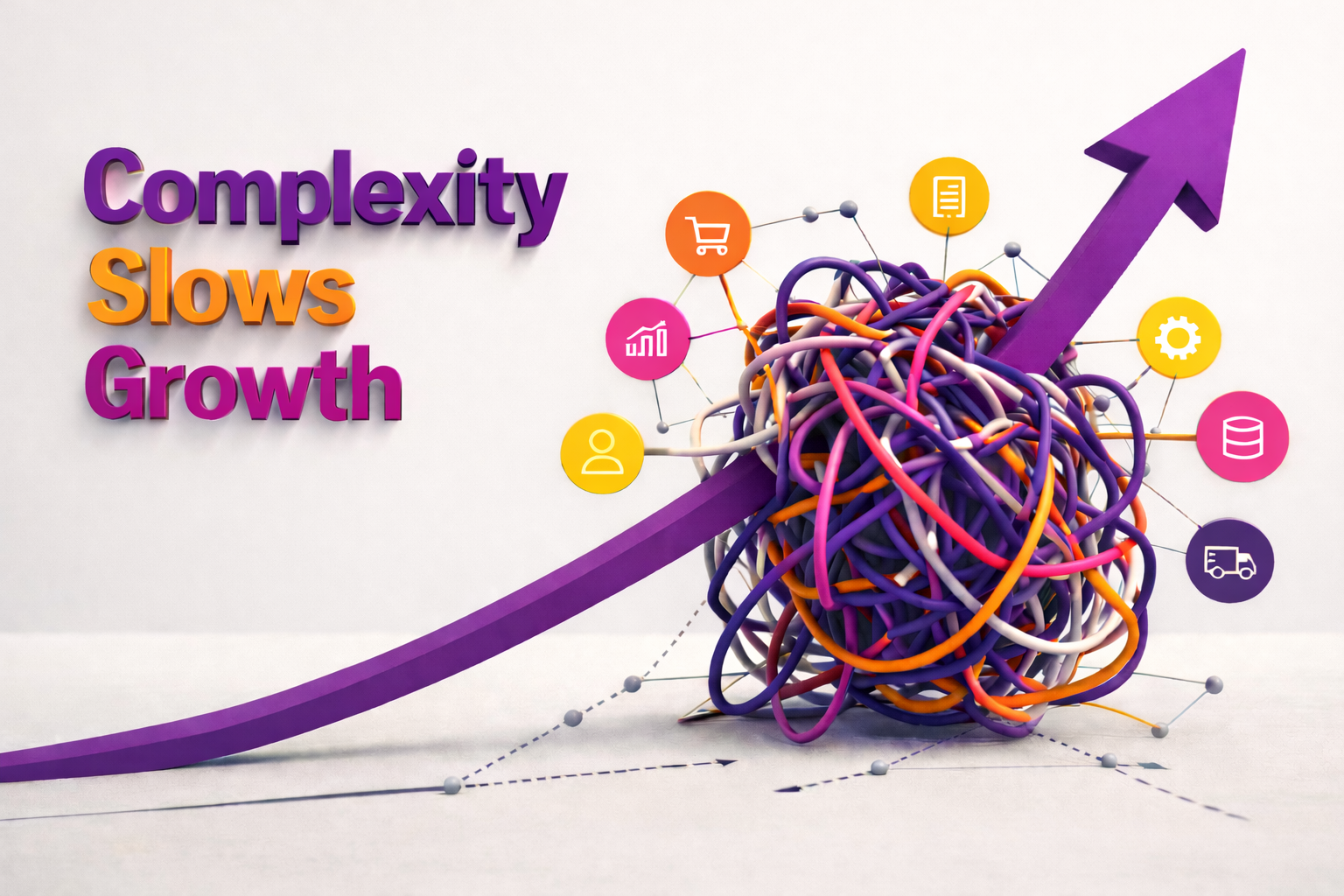
Growth in Business Central eCommerce often creates new opportunities — but it can also introduce complexity that slows execution, reduces efficiency, and limits scalability.
What begins as progress can quietly create structural strain, where systems, processes, and data become harder to manage, not easier.
For many organizations, growth is the primary objective.
More customers.
More orders.
More channels.
But as companies running Microsoft Dynamics 365 Business Central or NAV expand their digital capabilities, a different challenge begins to emerge – one that is less visible, but often more damaging over time.
Complexity.
Not the kind that appears in strategy discussions, but the kind that shows up in daily operations – slowing processes, introducing friction, and quietly limiting scalability.
This builds on our earlier discussion in The Executive Case for Reducing System Sprawl in Business Central eCommerce, where we explored how layered systems distribute business logic and reduce architectural control. Here, we shift focus to the operational impact – how that complexity affects execution, efficiency, and growth.
Growth Introduces Complexity Faster Than Expected
Growth rarely happens in a controlled, linear way.
New customers bring new requirements.
New channels introduce new workflows.
New expectations demand faster response times.
To support this, organizations often add:
- additional tools
- new integrations
- expanded system capabilities
Each decision is logical in isolation.
But over time, these additions create an environment where processes are no longer streamlined – they are interconnected, dependent, and increasingly difficult to manage.
As McKinsey highlights, leading organizations do not simply layer technology onto existing operations – they rethink how their operating model creates value. In Business Central environments, that distinction becomes critical. Without that alignment, each new capability can introduce friction rather than reduce it.
What Slows Growth in Business Central eCommerce
For COOs and operational leaders, the impact is rarely theoretical. It shows up in execution — where growth in Business Central eCommerce begins to slow under the weight of operational complexity, disrupting the day-to-day flow of orders, pricing, inventory, and control.
Order Processing Delays
As systems multiply, orders are more likely to be delayed by validation steps, handoffs, or exceptions that occur across platforms rather than within one governed environment.
Customer-Specific Pricing Inconsistencies
When pricing logic is split across systems, accuracy becomes harder to maintain — especially in organizations managing negotiated pricing, account-specific terms, and more complex customer relationships.
Inventory Synchronization Gaps
Inventory discrepancies become more likely when availability depends on data moving between environments rather than being governed in one operational core.
Manual Checks and Overrides
Instead of flowing cleanly through a controlled process, transactions increasingly require human intervention to validate, correct, or complete them.
These are not isolated issues.
They are symptoms of a broader structural problem — one where operations depend on multiple systems working in coordination, rather than a single system governing execution.
The Hidden Impact on Order-to-Cash and Fulfillment
One of the most critical areas affected by complexity is the order-to-cash cycle.
When eCommerce operates as a separate layer:
- orders may be captured in one system
- validated in another
- and finalized within the ERP
Each step introduces potential delays, errors, or exceptions.
Over time, this leads to:
- slower fulfillment
- increased operational overhead
- reduced confidene in timelines and commitments
For organizations that rely on precision – whether in manufacturing schedules or distribution logistics – these inefficiencies compound quickly.
Why Operational Teams Feel It Before Leadership Sees It
Complexity rarely appears first in executive dashboards.
It appears on the front lines.
Operational teams begin to:
- develop workarounds
- rely on manual processes
- spend more time managing systems than executing workflows
From a leadership perspective, performance may still appear stable.
But underneath, efficiency is eroding.
2025 research into digital transformation trends highlights that organizations are now moving beyond optimization toward full business model reinvention – driven in part by the need to address exactly this kind of structural complexity.
Simplifying the Operating Model in Business Central
Addressing complexity is not about reducing capability.
It is about simplifying how the business operates.
For organizations running Business Central, this means re-evaluating where processes are executed and where control resides.
When commerce is governed within the ERP:
- pricing and customer logic remain consistent
- inventory reflects real-time availability
- orders are processed as native transactions
- and workflows operate within a unified system
The result is not just efficiency.
It is clarity.
Part of a Larger Conversation on Business Central eCommerce
This article is part of a broader discussion on how architecture and system design impact business performance.
In The Hidden Cost of Adding Another Layer to Business Central eCommerce, we explored how complexity begins.
In The Executive Case for Reducing System Sprawl, we examined how that complexity affects architecture.
Next in the series
The Long-Term Cost of Choosing Convenience Over Architecture
A leadership perspective on how short-term decisions create long-term strategic limitations – and what organizations can do to avoid them.
What This Means for Operational Leaders
Growth should create opportunity – not friction.
But when complexity is left unaddressed, it becomes a limiting factor – one that slows execution, reduces efficiency, and constrains scalability.
For operational leaders, the goal is not simply to support growth.
It is to ensure the business can sustain it.
Sustaining growth in Business Central eCommerce depends on reducing complexity before it begins to limit execution, efficiency, and scale.
Simplify operations by aligning commerce inside your ERP.
Discover how ERP-governed commerce works inside Business Central