

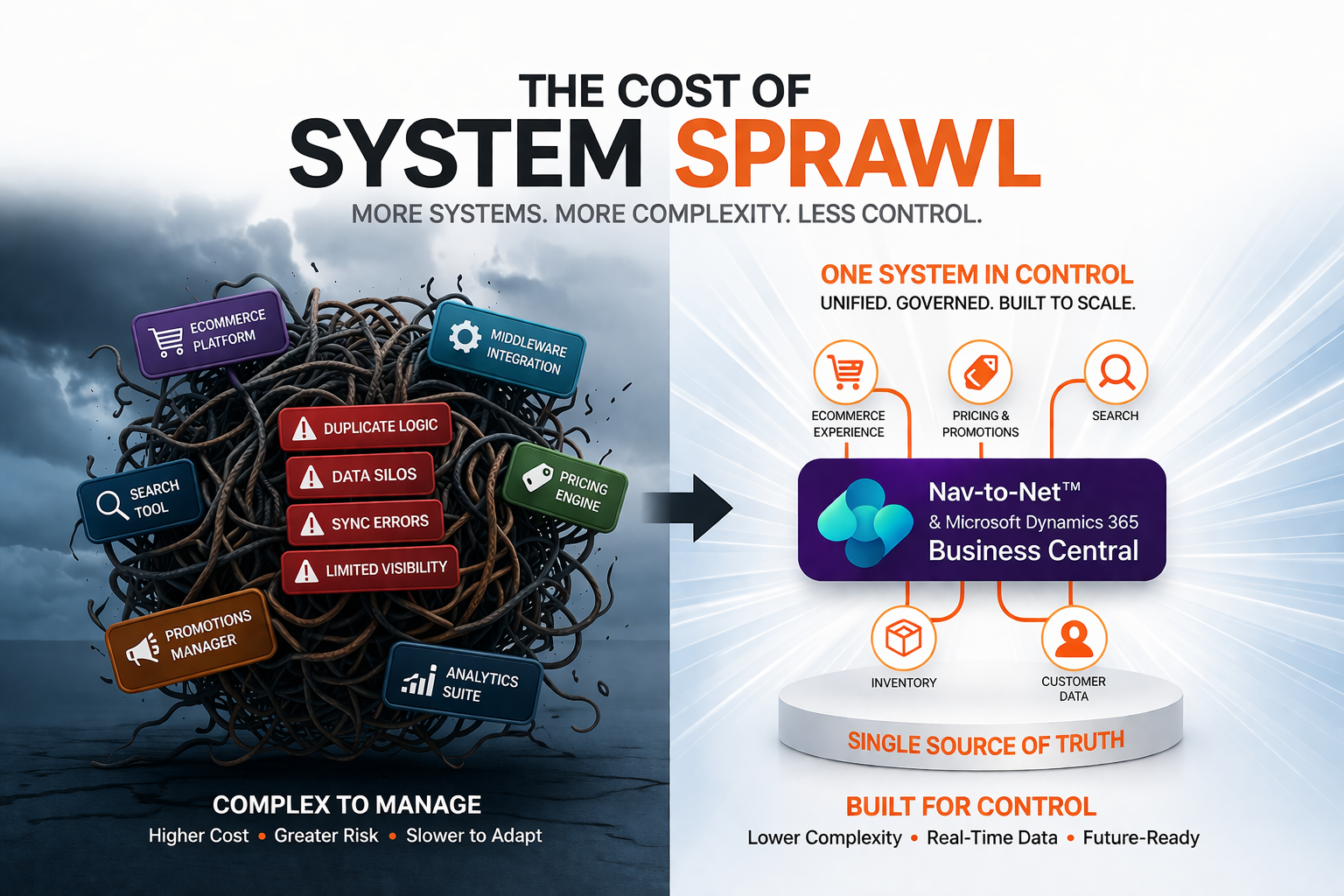
Why CIOs need to rethink architecture, control, and scalability in Business Central environments
System sprawl in Business Central eCommerce rarely happens all at once. It builds gradually as organizations add platforms, integrations, and tools over time.
For organizations running Microsoft Dynamics 365 Business Central or NAV, eCommerce decisions are often framed around features, integrations, and speed to launch.
But for CIOs, the more important question is rarely asked:
“What does this decision mean for our architecture over time?”
Because while adding systems can accelerate short-term progress, it often introduces long-term complexity – what many organizations are now recognizing as system sprawl.
This builds on our earlier article, The Hidden Cost of Adding Another Layer to Business Central eCommerce, where we explored how layered commerce environments introduce complexity over time and begin to weaken ERP control. Here, we take a closer look at how that complexity evolves into system sprawl – and what it means for architecture over time.
What System Sprawl Looks Like in Business Central eCommerce
System sprawl in Microsoft Dynamics 365 Business Central eCommerce does not happen all at once. It develops gradually.
A new eCommerce platform is introduced.
Middleware is added to connect it.
Additional tools soon follow for search, pricing, promotions, or analytics.
Each component serves a purpose.
But together, they create an environment where:
- business logic is distributed across multiple systems
- data must be continuously synchronized
- and no single system fully governs execution
As explored earlier, this layered approach often begins as a practical solution – but evolves into a structural challenge.
Why More Systems Create Less Control in Business Central Environments
At a glance, adding systems can feel like gaining capability.
In reality, it often reduces control.
As McKinsey’s Global Tech Agenda 2026 highlights, CIOs are increasingly acting as architects of business strategy – responsible not just for managing technology, but for shaping how it drives value across the organization.
In Business Central environments, this shift makes architectural clarity even more critical. Each additional system may add capability in the short term, but it can also introduce duplicated logic, increased synchronization requirements, and reduced visibility into how decisions are actually executed.
As system sprawl in Business Central eCommerce increases, business logic becomes more fragmented and harder to govern.
This typically results in:
- duplicate pricing logic across platforms
- fragmented ownership of business rules
- increased reliance on synchronization processes
- limited visibility into where decisions are actually made
“Which system is in control?”
The Architecture Problem Behind Integration Strategies
Many eCommerce solutions position themselves around integration – how well they connect to Business Central.
Integration matters.
But it does not solve the underlying architectural challenge.
Moving data between systems is not the same as governing how the business operates.
Research and executive guidance from Harvard Business Review consistently emphasize that transformation efforts succeed when systems align with the operating model – not when additional layers are introduced without structural alignment.
For CIOs, this distinction is critical.
Because once business logic is distributed across systems, architecture becomes reactive rather than intentional.
The Long-Term Impact on Maintainability and Scalability
System sprawl does not just affect today’s environment. It shapes what is possible tomorrow. Over time, what begins as flexibility in the architecture turns into dependency — making systems harder to maintain, adapt, and scale.
What Begins as Flexibility Becomes Dependency
As complexity grows, layered architectures introduce:
- higher maintenance overhead
- increased dependency on specialized integrations
- slower response to business changes
- greater risk during upgrades or expansion
What initially supported growth begins to constrain it.
This is especially visible in B2B distribution, manufacturing, and supply chain environments, where pricing complexity, order processing, and customer-specific workflows require precision and consistency.
When those processes depend on multiple systems, scalability becomes more difficult – not less.
Why CIOs Are Re-Evaluating Business Central Commerce Architecture
Many CIOs are now stepping back to reassess how eCommerce fits within their broader architecture — looking more closely at where control resides, how business logic is distributed, and whether the current model can support long-term scalability.
From Integration to Execution
“How does this integrate with Business Central?”
To asking:“Where should commerce actually be executed?”
This shift reflects a growing recognition that architecture – not integration – is what determines long-term success.Reducing System Sprawl Starts with the Right Foundation
Reducing system sprawl does not mean eliminating capability.
It means rethinking where that capability lives.
In an ERP-governed model:
- pricing, inventory, and customer data remain within Business Central
- business logic is centralized rather than duplicated
- orders are processed as native ERP transactions
- and the operating model remains unified
The result is not just a simpler architecture.
It is a more controlled, scalable, and resilient one.
Part of a Larger Conversation on Business Central eCommerce
This article builds on The Hidden Cost of Adding Another Layer to Business Central eCommerce and continues the discussion on how complexity evolves into system sprawl.
Next in the series
Why Complexity Is the Real Threat to Growth in Business Central eCommerce
An operational perspective on how layered systems affect execution, efficiency, and scalability across the business.
What This Means for CIOs
For CIOs, the goal is not to add more systems.
It is to build an architecture that supports the business — today and as it grows.
Reducing system sprawl in Business Central eCommerce is essential to restoring control, scalability, and long-term architectural clarity.
That means extending the value of Business Central rather than surrounding it with more layers. When commerce is built to work from the ERP outward, the business gains greater control, stronger alignment across operations, and a clearer path to scalable growth.
Because in the end, reducing system sprawl is not about simplification alone.
It is about maintaining control over how the business runs.
Start with your architecture. See how ERP-governed commerce works inside Business Central.
Schedule a personalized Nav-to-Net™ demo today!