

B2B eCommerce Is Becoming a Competitive Divide
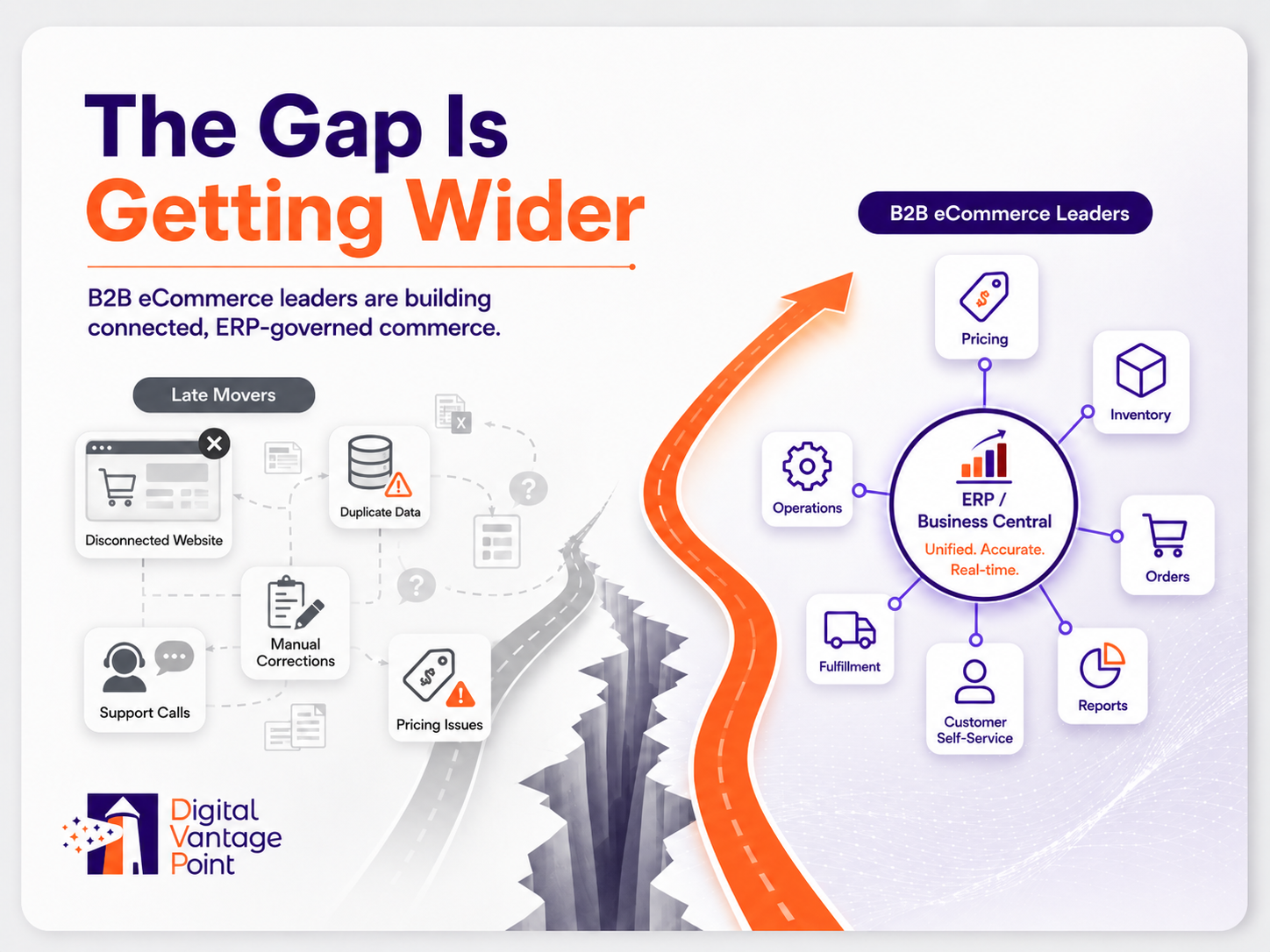
B2B eCommerce leaders are pulling ahead because their online channels do more than accept orders. They connect customer experience to ERP data, pricing, inventory, reporting, orders, fulfillment, and internal operations.
For manufacturers and distributors, B2B eCommerce is no longer only about offering customers another way to place orders.
It is becoming a competitive divide.
Some companies are turning eCommerce into a stronger business capability. They are connecting digital commerce to ERP data, customer-specific pricing, inventory, order history, account rules, fulfillment workflows, and internal operations. Their online channels are not perfect, but they are becoming more accurate, more trusted, and more useful to both customers and internal teams.
Other companies are still treating eCommerce as a separate web project. Their websites may accept orders, but the experience depends on duplicated data, manual corrections, disconnected workflows, and internal teams filling the gaps behind the scenes.
That difference matters.
A basic online store may help a company appear digitally available. But a mature B2B eCommerce model can help the business become easier to work with, easier to scale, and easier to trust.
For C-level leaders, this is where the conversation becomes more urgent.
The question is not simply whether the business has eCommerce.
The better question is whether the company’s eCommerce model is helping it move ahead or causing it to fall behind.
What Separates B2B eCommerce Leaders From Late Movers
B2B eCommerce leaders are not necessarily the companies with the flashiest websites or the longest feature lists.
They are the companies that understand eCommerce as part of the business operating model.
They know customers are not only looking for a digital catalog. Customers want accurate pricing. They want reliable availability. They want order history. They want account-specific information. They want invoices, reports, shipment updates, reorder tools, and confidence that what they see online reflects their actual relationship with the supplier.
Internally, eCommerce leaders also understand that the online channel must work for the business, not only for the website visitor. Sales teams need to trust what customers see online. Customer service teams need fewer repetitive questions. Finance needs pricing and account terms to remain governed. Operations needs online orders to arrive with the right information. IT needs an architecture that does not create unnecessary system sprawl.
That is what separates leaders from late movers.
Leaders treat B2B eCommerce as a connected business capability.
Late movers are more likely to treat it as a separate digital layer.
The difference may not be obvious on the first day a website launches. It becomes obvious over time as online order volume grows, customer expectations increase, and internal teams begin to feel either more supported or more burdened by the channel.
Why the Gap Between B2B eCommerce Leaders and Late Movers Is Getting Wider
The gap between B2B eCommerce leaders and late movers is widening because customer expectations and operational pressure are rising at the same time.
Customers want more digital access, but they also want accuracy. They expect more self-service, but they still need account-specific rules and reliable support. They want faster answers, but they are not willing to accept incorrect pricing, incomplete order information, or confusing availability.
At the same time, manufacturers and distributors are dealing with margin pressure, supply chain complexity, labor constraints, customer retention concerns, and rising expectations for operational efficiency.
That combination changes the role of eCommerce.
When the online channel is mature, it can help reduce pressure. Customers can answer more questions themselves. Routine orders can move more efficiently. Sales and service teams can focus on higher-value work. ERP data can support a more consistent customer experience. Executives can gain more confidence in the digital channel.
When the online channel is immature, it can add pressure. Customers may ask more questions. Orders may need more corrections. Pricing discrepancies may increase. Inventory issues may become more visible. Internal teams may need to maintain duplicated logic. IT may need to support more integrations and exceptions.
That is why the gap widens.
B2B eCommerce leaders build systems that reduce friction as they scale.
Less mature eCommerce models often create more friction as they grow.
Customer Experience Now Depends on Operational Accuracy
In B2B commerce, customer experience is not only about how the website looks.
It is about whether the business can provide reliable information and fulfill customer expectations.
For manufacturers and distributors, this is especially important because the buying experience often depends on operational details. Customers may need to know whether products are available, whether lead times are realistic, whether backorders can be managed, whether substitutions exist, whether shipment timing is clear, and whether pricing reflects their account terms.
These details are not separate from customer experience.
They are customer experience.
Gartner’s Future of Supply Chains 2026 notes that backorders, low inventory, increased prices, and delayed shipments can threaten customer loss, while executives increasingly expect supply chains to support growth and reduce costs.
For B2B eCommerce, that creates an important executive implication: the online channel cannot promise what the business cannot support.
If customers see inaccurate availability, they lose trust. If pricing is wrong, they hesitate. If shipment expectations are unclear, they call. If backorders are poorly communicated, frustration increases. If online information does not match the account relationship, customers may question the reliability of the supplier.
That is why B2B eCommerce leaders connect the digital experience to operational truth.
They understand that online commerce must reflect the realities of inventory, pricing, fulfillment, account rules, and order flow.
Why Disconnected Commerce Creates Competitive Risk
Disconnected commerce may not look risky at first.
A company launches a website. Customers can browse products. Orders can be submitted. The project appears successful.
But over time, disconnected commerce can create competitive risk.
If product data is maintained separately, it can become inconsistent. If pricing logic is duplicated, it can become unreliable. If inventory information is delayed, customers may not trust availability. If online orders require manual review, the business may not gain the efficiency it expected. If customer-specific rules are handled outside the ERP, internal teams may need to manage exceptions manually.
These issues affect more than operations.
They affect customer trust.
A customer who cannot trust the website may return to phone or email. A buyer who cannot access accurate order history may keep relying on customer service. A purchasing team that sees inconsistent pricing may hesitate to adopt the online channel. A dealer or distributor who cannot access the right catalog view may become frustrated. A branch or ship-to location that cannot see relevant account information may continue working around the system.
The website may still exist, but the business has not created true digital leverage.
That creates competitive risk because companies with more mature eCommerce models become easier to work with. They reduce friction. They give customers more confidence. They allow internal teams to support growth more efficiently. They make ERP data more useful across the customer relationship.
In a market where customers have options, ease of doing business matters.
The B2B eCommerce Leader’s Advantage: ERP-Governed Commerce
For companies using Microsoft Dynamics 365 Business Central, one of the strongest ways to close the maturity gap is to build eCommerce around ERP-governed commerce.
ERP-governed commerce means the online buying experience is shaped by the same system of record and business logic that already guide the company’s operations.
That does not mean every customer-facing experience needs to be rigid or overly complex. It means the online channel should reflect the data, rules, and workflows that matter most to the business.
For manufacturers and distributors, that often includes:
- Customer-specific pricing
- Product and item data
- Inventory availability
- Account terms
- Credit rules
- Order history
- Reorder logic
- Ship-to locations
- Approval workflows
- Invoices, reports, and account information
- Order status and fulfillment details
- Catalogs or product access by customer, account, or role
When these elements are governed through Business Central, eCommerce becomes more consistent with how the business actually operates.
That creates an advantage.
Customers gain more reliable information. Sales and customer service teams can trust what customers see. Finance maintains control over pricing and account logic. Operations receives better order information. IT supports a cleaner architecture. Leadership gains a commerce model that can scale with less avoidable complexity.
That is what B2B eCommerce leaders are moving toward.
Not just more digital activity.
More governed digital commerce.
Why More Online Volume Can Create More Work for Less Mature eCommerce Models
One of the biggest risks of immature eCommerce is that growth can make the problem worse.
If online order volume increases but the channel is not aligned with ERP data and business rules, internal workload may grow with it.
More orders may require more manual reviews. More customer activity may create more support questions. More product visibility may lead to more pricing confusion. More self-service may create more exceptions. More integrations may require more maintenance.
That is not scalable growth.
It is digital volume layered on top of operational complexity.
This is why executives need to look beyond the launch of an online store. A site that accepts orders may appear successful at first, but the real test is what happens as adoption grows.
A stronger eCommerce model should improve three areas:
1. Business Efficiency
The online channel should help the business process more activity without adding unnecessary manual work.
Orders should flow with fewer corrections. Sales and customer service teams should spend less time on routine order questions. Internal teams should not need to review, rekey, or correct every transaction before it can move forward.
2. Customer Adoption
Customers should rely on the online channel because it gives them accurate, useful information.
They should be able to trust pricing, availability, account details, order history, and reorder options. If customers still need to call or email to confirm basic information, the online channel is not delivering enough value.
3. ERP Confidence
Leadership should have confidence that the online channel is still governed by the right system of record.
Business Central should remain central to pricing, inventory, customer data, orders, reporting, and business rules. As eCommerce activity grows, the company should gain more confidence in the data behind the channel, not less.
If these areas do not improve as adoption grows, the business may have created another channel without solving the underlying maturity issue.
Where Leaders Focus Their eCommerce Strategy
B2B eCommerce leaders focus on the business outcomes behind the channel.
They do not only ask which platform can launch quickly or which front-end features are available. They ask what eCommerce needs to improve across the business.
A stronger strategy usually focuses on these areas:
Customer Trust
Customers need to trust the information they see online.
That means pricing should reflect the account relationship. Product information should be relevant. Inventory or availability expectations should be reliable. Order history should be accessible. Account details should be accurate. Reorder tools should work the way customers actually buy.
When customers trust the channel, adoption becomes easier.
When they do not, they revert to manual channels.
Operational Efficiency
eCommerce should reduce avoidable internal work.
That means online orders should not routinely require rekeying, pricing correction, manual validation, or unnecessary customer service intervention. Sales and service teams should be able to focus on higher-value work. Operations should receive better order information. Finance should not lose control over pricing, terms, or account rules.
When eCommerce improves operational flow, it creates business leverage.
When it adds work behind the scenes, it creates hidden cost.
ERP Alignment
Business-critical commerce logic should remain connected to the system of record.
For Business Central companies, that means pricing, customer data, item information, inventory, orders, account rules, and financial logic should not be duplicated unnecessarily across systems.
When Business Central remains central to the commerce model, the company can maintain stronger governance.
When eCommerce is managed as a separate layer, the business may create complexity that becomes harder to unwind later.
What Companies Falling Behind Often Miss
Companies falling behind in B2B eCommerce often underestimate the complexity behind the transaction.
They may focus on launching a website without fully considering the customer-specific rules, operational dependencies, and ERP data required to support the experience.
They may assume integration alone will solve the problem.
They may treat eCommerce as a marketing or IT project instead of a cross-functional business initiative.
They may prioritize front-end design before determining how pricing, inventory, account rules, order flow, and customer data should be governed.
They may measure success by launch date instead of adoption, efficiency, accuracy, and customer trust.
These missteps are common because the visible part of eCommerce is the website. But the value of B2B eCommerce depends heavily on what happens behind the website.
For manufacturers and distributors, that back-end alignment is where the real maturity gap appears.
A company can launch an attractive portal and still struggle with online pricing, inventory accuracy, customer-specific rules, and order processing. Another company may launch a more focused experience that creates greater business value because it is aligned with the ERP foundation.
That is why leaders and late movers are not separated only by design.
They are separated by governance, architecture, and operational readiness.
A Practical Readiness Test for C-Level Leaders
Executives do not need to evaluate every technical detail of an eCommerce solution, but they do need to ask whether the company is building a model that can scale.
A practical readiness test should look at the following three areas:
1. Customer Readiness
Is the online channel strong enough for customers to trust it?
- Customers can see the right products for their account
- Pricing is accurate and aligned with Business Central
- Order history, invoices, and reports are accessible where appropriate
- Reordering is simple and reliable
- Availability and fulfillment expectations are clear enough to support buying decisions
2. Operational Readiness
Is the business prepared to support more digital volume without adding more manual work?
- Online orders move through the business with fewer corrections
- Sales and customer service teams can trust what customers see
- Finance maintains control over pricing and account rules
- Operations receives the right order and fulfillment information
- Exceptions are intentional, not the result of disconnected systems
3. Architecture Readiness
Is eCommerce governed by the right system of record?
- Business Central remains central to pricing, customer data, inventory, orders, and financial logic
- Business rules are not unnecessarily duplicated across systems
- Integrations do not become the primary source of business logic
- Data governance is clear
- The online channel can grow without creating unmanaged complexity
These areas help executives evaluate whether eCommerce is creating long-term business value or simply adding another digital layer.
Why Business Central Companies Have an Opportunity to Lead
Manufacturers and distributors using Business Central already have many of the building blocks required for mature B2B eCommerce.
Business Central often manages customer records, item data, pricing, inventory, orders, invoices, financials, and operational workflows. It already supports many of the decisions that affect the buying experience.
The opportunity is to extend that foundation into eCommerce in a way that improves both customer experience and business control.
That does not mean every company needs every feature at once. It means the eCommerce roadmap should be built around business priorities.
For some companies, the priority may be accurate online ordering for existing customers.
For others, it may be customer-specific pricing, reorder tools, invoice access, account self-service, dealer portals, inventory visibility, or reducing manual order entry.
The right path depends on the business.
But the strongest strategies usually share one principle: the online channel should not operate separately from the business logic that already governs the company.
That is where Business Central companies can lead.
They can build commerce models that are not just digital but governed.
The Business Case for Closing the Maturity Gap
The gap between B2B eCommerce leaders and late movers is not only a technology gap.
It is a business performance gap.
Companies with more mature commerce models are better positioned to improve customer experience, reduce manual work, protect pricing accuracy, strengthen ERP value, and scale digital activity with more control.
Companies with less mature models may still accept online orders, but they may struggle to create meaningful business leverage. They may continue relying on sales, service, finance, operations, and IT teams to compensate for gaps in the online experience.
For C-level leaders, the business case is clear. B2B eCommerce should help:
- Make the company become easier to work with
- Customers buy with confidence
- Internal teams by allowing them to operate more efficiently
- Extend ERP value into the customer relationship
- Leadership scale digital commerce without adding unnecessary complexity
That is what separates a basic online channel from a mature commerce model.
What Defines a B2B eCommerce Leader?
A B2B eCommerce leader is a company that treats eCommerce as part of the business operating model, not just a separate website. For manufacturers and distributors, that means the online channel is connected to ERP data, customer-specific pricing, inventory, order history, invoices, reports, account rules, fulfillment workflows, and operational processes.
B2B eCommerce leaders are more likely to create online experiences that customers can trust and internal teams can support. Late movers may still accept online orders, but they often rely on duplicated data, manual corrections, disconnected workflows, and internal teams filling the gaps behind the scenes.
The Final Takeaway From the Series
Across this series, the message is consistent.
B2B eCommerce maturity matters because manufacturers and distributors need more than another online channel.
In Article 1, we looked at why B2B eCommerce maturity matters more than simply adding another place for customers to transact.
In Article 2, we explored why ERP investment should do more than run the back office and why Business Central should help shape the customer-facing commerce experience.
In Article 3, the conclusion is clear: the companies that connect eCommerce to ERP data, customer rules, pricing, inventory, orders, and operations will be better positioned than companies that treat eCommerce as a disconnected web project.
The gap between leaders and late movers is getting wider because customers expect more, operations are under pressure, and disconnected systems are harder to justify.
A website can create digital access.
A mature, ERP-governed commerce model can create business advantage.
Frequently Asked Questions About B2B eCommerce Leaders and Late Movers
What makes a company a B2B eCommerce leader?
A B2B eCommerce leader connects the online buying experience to the company’s ERP data, pricing, inventory, orders, reporting, account rules, and operations. The goal is not only to take orders online, but to create a more accurate, scalable, and trusted commerce model.
Why are late movers falling behind in B2B eCommerce?
Late movers often treat eCommerce as a separate website instead of a connected business capability. This can lead to duplicated data, pricing issues, manual order corrections, disconnected workflows, and lower customer confidence.
How does Business Central support stronger B2B eCommerce?
Microsoft Dynamics 365 Business Central can support stronger B2B eCommerce by keeping pricing, customer data, inventory, orders, invoices, reporting, and business rules connected to the system of record. This helps the online channel reflect how the business actually operates.
Why does ERP-governed commerce matter?
ERP-governed commerce matters because customers need accurate information and internal teams need control. When eCommerce is governed by Business Central, companies can reduce manual work, protect pricing accuracy, improve customer self-service, and scale digital commerce with more confidence.
Ready to Strengthen Your B2B eCommerce Strategy?
Digital Vantage Point helps manufacturers and distributors using Microsoft Dynamics 365 Business Central create ERP-governed eCommerce experiences that are fully managed inside Business Central.
Powered by Nav-to-Net™ (NTN), DVP’s purpose-built ERP-governed eCommerce solution for Business Central, companies can extend ERP value beyond the back office and into the customer-facing buying experience while keeping pricing, inventory, customer data, orders, reporting, and business rules aligned with the ERP.
NTN is designed to support the ERP value areas discussed in this article, including customer self-service, account-specific pricing, inventory visibility, order history, invoice access, ERP alignment, and a more scalable Business Central eCommerce model.
If your organization is evaluating B2B eCommerce, replacing a disconnected platform, or trying to get more value from your Business Central investment, DVP can help you assess what a more mature commerce model should look like for your business.
A B2B eCommerce leader connects the online buying experience to the company’s ERP data, pricing, inventory, orders, reporting, account rules, and operations. The goal is not only to take orders online, but to create a more accurate, scalable, and trusted commerce model.
Schedule a personalized walkthrough to see how Nav-to-Net™ helps customers order online while keeping commerce governed by Business Central.
Close the B2B eCommerce maturity gap with ERP-governed commerce inside Business Central

Read the Earlier Articles in the Series
The B2B eCommerce Maturity Series explores how manufacturers and distributors using Microsoft Dynamics 365 Business Central can evaluate eCommerce maturity, extend ERP value, and build a stronger commerce model.